
Ridgway Criminal History Checks
A local search works best when it begins with the event, not a person-only query. Note the date, place, responding agency, and any citation or case number. Those facts show whether the Town Marshal, Town Clerk, Sheriff, regional jail, or court is likely to hold the next record. Ridgway has no single portal that combines them.
- Ask the Ridgway Marshal about a Marshal-created incident, citation, or arrest record.
- Use the Town Clerk and administrative forms hub for town-held records and a written request route.
- Contact the municipal clerk about a town ordinance summons or municipal docket.
- Check the Montrose jail channel and Ouray Combined Court for custody and state-filed charges.
- Use Colorado Bureau of Investigation channels when statewide Colorado criminal history is needed.
The official Town of Ridgway site is the sound starting point for current offices and forms. It keeps the inquiry tied to the town instead of a commercial people-search product.
Ridgway Records at Town Hall
Town Hall at 201 N. Railroad Street is Ridgway's administrative records front door. The Town Clerk handles organizational records and can route a focused request when no dedicated criminal-justice portal exists. Mailing requests may use P.O. Box 10, Ridgway, CO 81432, and the main town number is 970-626-5308. A useful request names the exact record, date range, location, agency, and known identifier.
The Town Clerk page describes the office and supplies current contact context.  The image reinforces why a town-held file should begin at the clerk rather than at a county office that never created it.
The town also maintains an administrative information and forms hub.  That hub supports the written fallback, but a general CORA form does not by itself turn into a name-based criminal-history search.
Records at the Ridgway Marshal
The Ridgway Marshal is the local law-enforcement custodian for Marshal-created incidents. Call 970-626-5196 for the current request path. WestCO regional nonemergency dispatch is available at 970-249-9110 when the issue concerns a recent call or responding agency. Do not use 911 for a routine records inquiry.
A Marshal report may contain an incident narrative, officer observations, citation facts, and supplemental material. Release is reviewed under Colorado criminal-justice records law. Active-investigation details, victim information, juvenile material, or data protected by a court order may be withheld or redacted. If a Sheriff deputy or State Patrol trooper responded instead, ask that agency. The town cannot release a file outside its custody.
Ridgway Agency Names Control Access
Myth: every event inside Ridgway produces a town record. Fact: jurisdiction and the responding badge control custody. The Marshal keeps Marshal files. The Ouray County Sheriff retains Sheriff reports. Colorado State Patrol handles its highway enforcement and crash records, which matters along U.S. 550 and Highway 62. A shared dispatch call does not merge those files.
- Incident record
- The responding agency's account of a reported event or investigation.
- Booking record
- The regional jail's intake and custody file after an arrest.
- Court file
- The pleadings, settings, orders, disposition, and sentence after charges are filed.
- Criminal history
- A person-centered state compilation that may receive fingerprint arrest and disposition data.
These records can describe the same event while showing different facts and dates.
A citation can identify the Ridgway Marshal while a later jail entry identifies Montrose as custodian. The court file may use a new case number and a charge selected by the prosecutor. Keep each number with its source. That step helps the next office locate the right file and prevents a booking allegation from being confused with a court result.
Booking and Arrest Records in Ridgway
Ridgway does not operate the county's booking jail. A person arrested locally may be transported to the Montrose County Detention Facility for formal intake. The arresting agency creates the report; Montrose creates the booking and custody record. Search the official Montrose inmate list by name for current custody, or call the booking desk at 970-252-4072 when a fresh intake has not appeared.
For wider detail on the regional handoff, use the county arrest search resource. The public list is not a historical archive and does not replace the Marshal narrative. Intake may include identity verification, fingerprints, a photograph, charge-at-booking data, bond processing, and release or transfer entries. Filed charges can later differ.
Ridgway Activity in Sheriff Blotters
The Ouray County Sheriff's weekly blotter can reveal Ridgway-area calls, warrant activity, road incidents, and agency assistance. It is an event log, not a named criminal history or booking roster. Entries tend to use dates, call types, and general places. They do not establish guilt, and they may omit names, birth dates, bond, booking numbers, and final court outcomes.
The Ouray County Sheriff site provides current service and records routes. Use a blotter entry as a lead, then request the source report from the responding agency and check the filed court case if one exists.
A call label also needs care. Suspicious conduct shows why an officer was sent, not what the officer proved. A warrant attempt does not show that a warrant was served or remains active. For a current warrant concern, call the issuing court or law-enforcement agency. Do not rely on an old blotter line to decide whether court action is still required.
The Ridgway Municipal Court File
A town summons for an ordinance matter belongs to the Ridgway municipal channel. No official public Ridgway case-search portal was located in the research. The dependable fallback is the town phone and counter route. Ask whether a municipal file exists, what identifier is required, and how copies and any current charges are handled before sending payment.
| Court Name | Ridgway municipal court or town clerk channel |
|---|---|
| Case Types Heard | Town ordinance matters and municipal summonses |
| Case Lookup Channel | Town Hall phone, clerk counter, or focused records request |
| What the Docket Shows | Verify citation, settings, plea, order, judgment, and payment status with the clerk |
| Copies & Fees | Ask the town for the current format, estimate, and fee before ordering |
A state misdemeanor or felony is different. Those files belong at Ouray Combined Court, even when the police contact occurred inside Ridgway.
Give the citation number, name, issue date, and hearing date if known. Ask for the docket first, then name the particular order or judgment needed. This gives the clerk a clear task and avoids a broad demand that mixes court material with police reports the clerk may not possess.
Ridgway Summons or County Case
The agency and charge type prevent a common search error. A Ridgway ordinance summons stays with the municipal system. A Colorado criminal charge moves into County or District Court at the Combined Court. A person may need both channels when one event produces a local citation and a separate state filing.
| Clue | Start here | Record expected |
|---|---|---|
| Town ordinance or municipal summons | Ridgway clerk | Municipal docket and order |
| State misdemeanor or traffic case | Ouray County Court | Register, filings, disposition |
| Felony filing | Ouray District Court | District criminal case file |
| Marshal arrest report | Ridgway Marshal | Incident and arrest narrative |
How Ridgway Records Reach the County
A town arrest does not remain in one cabinet. The Marshal report stays with its creator. The regional jail records intake and custody. Prosecutors decide what state charge to file, and Ouray Combined Court maintains the resulting case. Fingerprint-supported events and later dispositions can then reach the Colorado Bureau of Investigation.
Record flow: Ridgway Marshal › Montrose regional booking › Ouray County Courts › Colorado Bureau of Investigation
Recent activity is most likely to be found with the local agency or booking desk. A court disposition appears only after filing and court action. A state history may lag or miss a summons that never produced a fingerprint cycle. Compare sources rather than treating one silent result as proof that nothing happened.
If sources conflict, order the court disposition and use the CBI correction process when state history lacks the final result. A mismatch is not the same as sealing. Sealing limits public access through a court process, while correction supplies missing or wrong data to the repository.
Ridgway Public Safety Context
Ridgway's mountain roads, emergency calls, and small-town scale shape its records. The town plans and studies library supplies local context.  Public plans explain town operations, but they are not substitutes for an incident report or court docket.
The official Ridgway homepage identifies current town services.  That distinction matters when search results mix planning documents, meeting records, police contacts, and court material under the broad label of public records.
Ridgway Registry and Victim Channels
Sex-offender information uses a countywide channel rather than a town-only database. The Ouray County registry page explains the local list and Ridgway contact option. 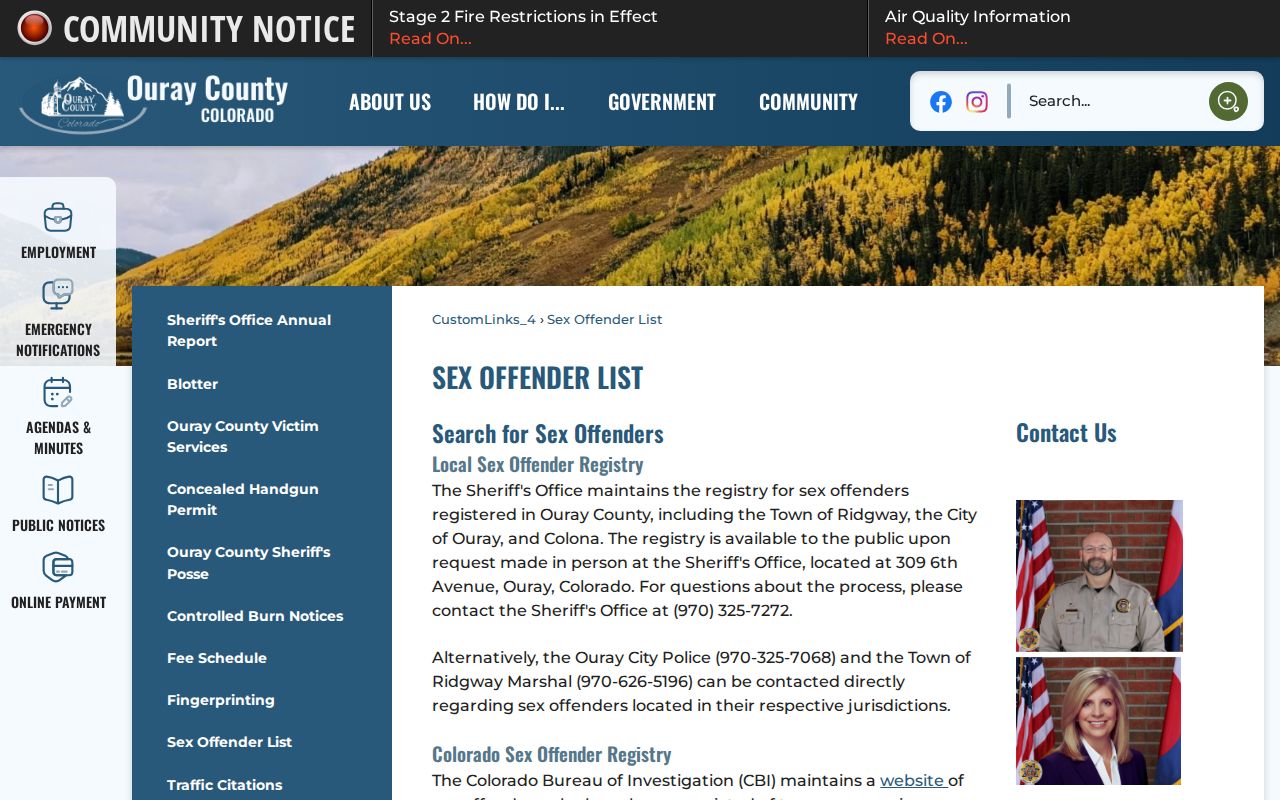 Registry information has a narrow public-safety purpose and cannot lawfully be used to harass or intimidate.
Shared support also crosses town lines. Ouray County Victim Services describes the joint service that dates to 2015. 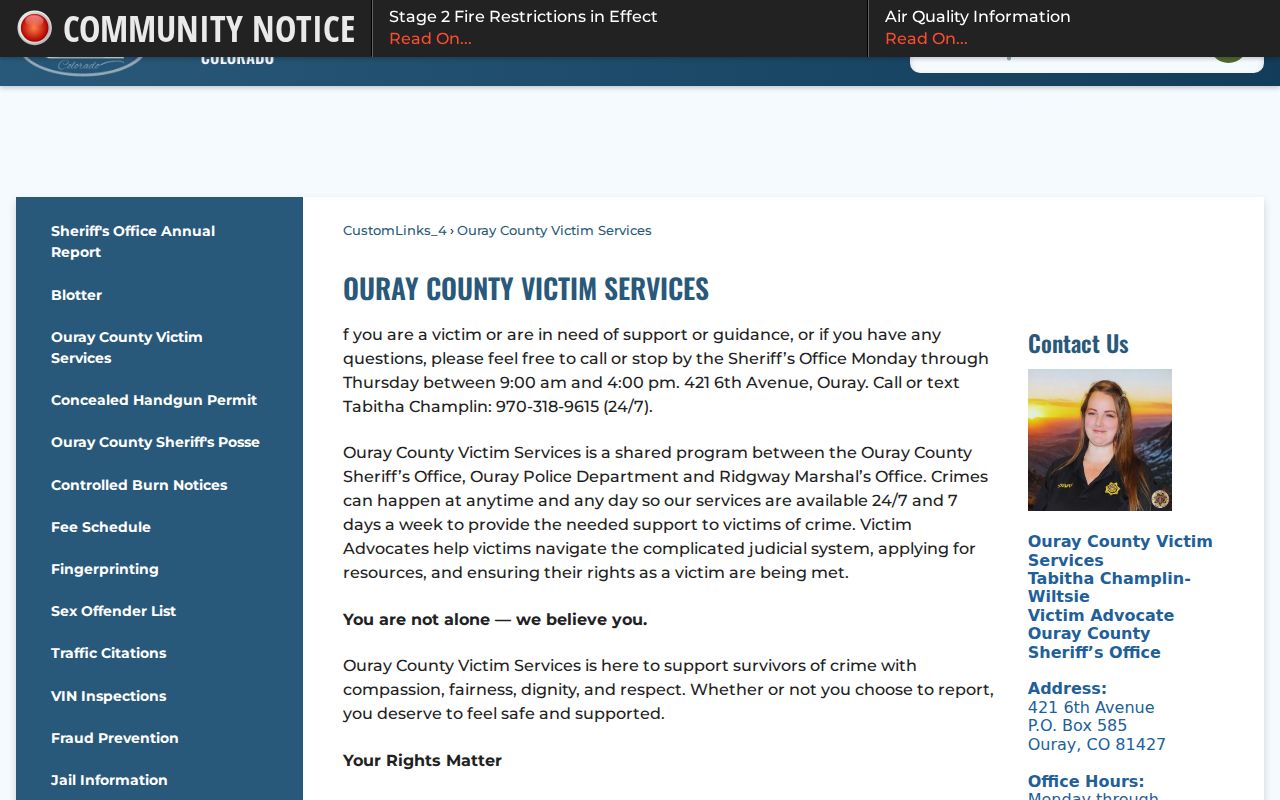 Its role is support and referral, not public criminal-history disclosure, so records still come from the proper custodian.
Ridgway Record Access Rules
Colorado separates general public records from criminal-justice records. The Colorado Open Records Act can govern town administrative material. Police and Marshal records are reviewed under the Colorado Criminal Justice Records Act, or CCJRA. Court access follows Judicial Department policy and any sealing or redaction order. A request may be narrowed, delayed, redacted, or denied when law protects an active case, juvenile, victim, private data, or sealed matter.
Key Statutes:
Colorado Criminal Justice Records Act, C.R.S. §§24-72-301 through 309 governs inspection and release by criminal-justice custodians.
C.R.S. §24-72-305 permits denial when law, a court rule or order, protected content, or the public interest supports withholding.
Chief Justice Directive 05-01 sets public access rules for Colorado court records.
Ask for the custodian's written reason if access is limited. A focused request often produces a clearer answer than a demand for every record tied to a name.